
The Shrinking Brain
From the Neolithic to artificial intelligence: what happens to a brain when it delegates

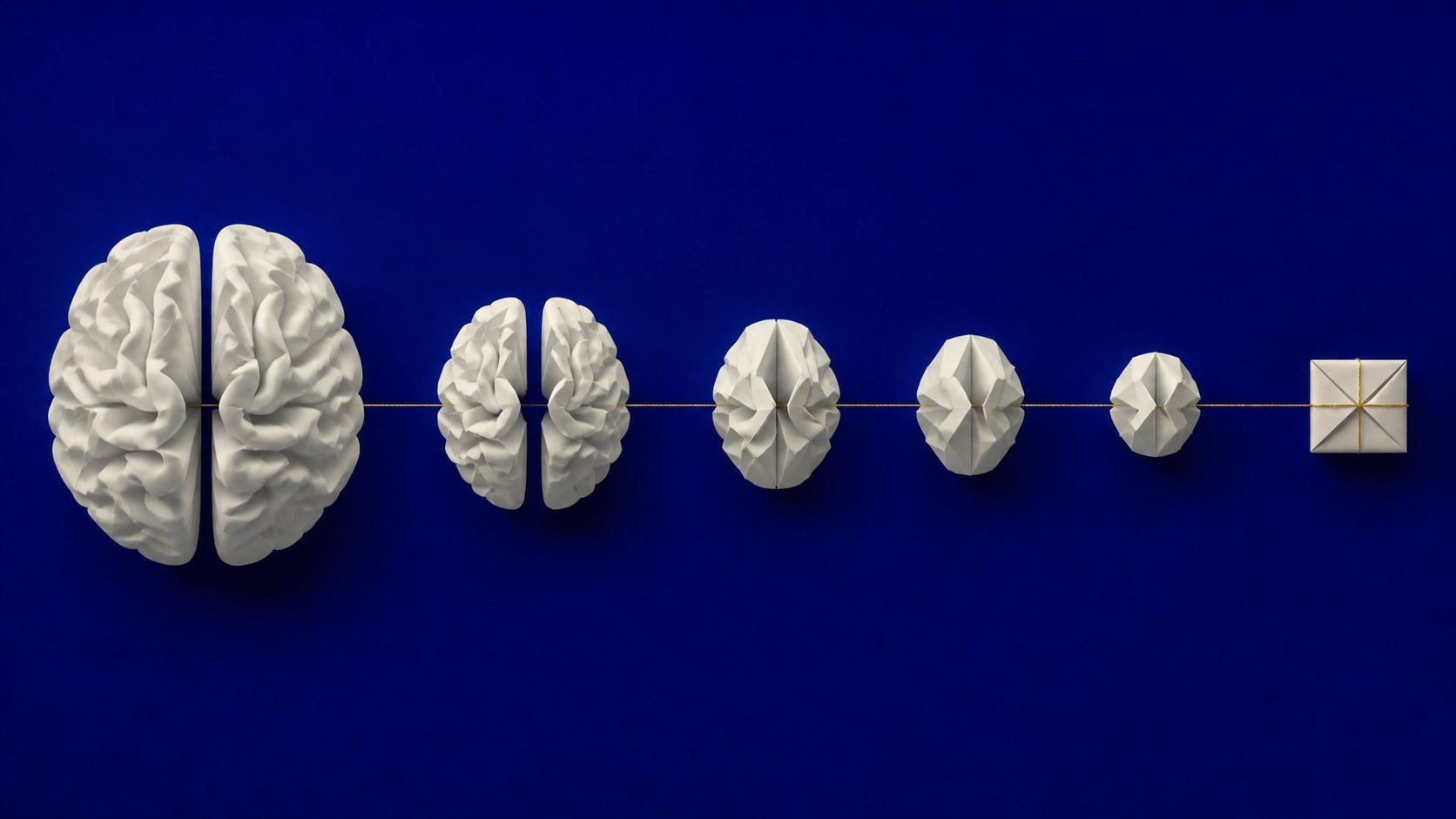
While preparing for my psychobiology exam I stopped on a piece of data I was not expecting: for roughly nine thousand years, the volume of the human brain has been decreasing. The reduction begins with the Neolithic, that is, at the moment when agriculture and animal husbandry made survival less dependent on the abilities of the single individual: once the cultivated field, the grain store and the cooperating village exist, making it to nightfall no longer requires all the ingenuity that a hunter-gatherer needed. And a large brain, as we will see, is a metabolic luxury: when the environment stops demanding it, over the course of generations natural selection tends to favour cheaper versions.
If a reduction of this kind took place when we delegated survival to the plough and the granary, what should we expect from a technology that offers to do our reasoning for us?
Two million years uphill, nine thousand downhill
The earlier trajectory had been unambiguous. Australopithecus afarensis, the oldest species of which we possess abundant remains, had a brain of 462 grams, barely larger than a chimpanzee's. Homo sapiens has about 1,350. Nor was it only mass that grew: what expanded selectively was the association cortex, the part that integrates information from the different sensory regions and governs elaborate behaviour. In our species the association areas are three to four times more extensive than in the other great apes and make up 84% of the neocortex. At equal body size with an insectivore, the cortex of a lemur is fifteen times larger, that of a monkey forty-five times, ours one hundred and fifty-six.
An organ like this comes at a price. The adult brain absorbs about a fifth of basal metabolism, and in the newborn the share is far higher: it is the most expensive tissue we carry. Natural selection does not maintain such a structure for free. It keeps it as long as it pays, and stops paying for it when the environment changes the terms of the contract.
This is precisely the explanation the literature proposes for the Neolithic reversal. Agricultural society poses new problems, but in the same movement it supplies solutions: technology, the organisation of labour, institutions that take on what previously fell to the individual. In that context, a brain of the volume our species had developed while facing the environment bare-handed becomes partly unnecessary. The consequence is what we read in the skulls: nine thousand years of slow contraction.
A caution is in order here, because on this terrain the science is less unanimous than the textbooks suggest. Brains do not fossilise: what we measure in the remains is cranial capacity, the internal volume of the skull, which is the best available approximation of the brain it contained. On these measurements the majority reading, supported by nearly ninety years of studies (DeSilva et al., 2021, 2023), sees a reduction over the last few millennia; a reanalysis of the same data concludes instead that cranial capacity has remained stable over the last three hundred thousand years (Villmoare and Grabowski, 2022). And even among those who take the reduction as established, the weight of the causes remains open: selective pressures eased by life in complex societies, but also bodies that became smaller and diets that worsened with agriculture, factors that act on individual development more than on genes. The precedent, then, should be handled for what it is: a robust clue that when the environment stops demanding a function, that function tends to scale down.
The reversal of sign
For two million years, the tool demanded brain, though not on its own. The production of stone tools involves long, hierarchically organised motor sequences, and passing them on requires social learning; group living, for its part, demands the recognition of conspecifics and a memory for relationships, to the point that in Robin Dunbar's classic analysis (1992) group size accounts for 46% of the variation in primate neocortex (a contested primacy: more recent studies assign at least equal weight to diet; DeCasien et al., 2017; Grabowski et al., 2023). Onto this web of pressures was grafted the feedback loop the textbooks call gene-culture coevolution: more brain produces better techniques and tools, which open new possibilities and in turn select for more brain. With one qualification the fossil record imposes: the relationship was never mechanical, because for hundreds of thousands of years brains grew while stone technology remained almost unchanged. But the direction of the relationship is clear: the tool, in that phase, demanded capacities rather than replacing them.
With the Neolithic the relationship reverses. When tools and institutions become effective enough to solve the problem in the individual's place, the pressure that maintained the costly organ slackens; if the Holocene reduction of the brain is real, as the majority reading indicates, it is the trace of this reversal.
To which of the two phases does artificial intelligence belong?
It seems like AI is being presented as the technology of substitution in its most complete form, and it acts more deeply than any previous tool, because it does not relieve us of a circumscribed ability such as calculation or orientation: it offers to relieve us of the operation of reasoning about a problem.
My own first conclusion, in front of these data, was that history would repeat itself: that artificial intelligence would ease the selective pressures on our cognitive capacities as agriculture once eased them, and that our descendants would be born with smaller brains. It does not hold, and working out exactly where it breaks is what led me to the real ground for concern.
In the Neolithic, the reduction did not happen because individuals used their brains less and passed that disuse on to their children. That is Lamarck’s position, and genetics has refuted it: what we do or do not do with our nervous system in the course of a life does not enter the germ line. The reduction happened through differential selection, that is, because across hundreds of generations one configuration left more descendants than another. It is an extremely slow process, and it requires the pressure to remain stable for millennia.
Artificial intelligence has been widely available for less than two generations, and it changes form at the speed of light. It will not manage to write anything measurable into the genome for centuries, and in any case not through disuse. But it acts on an incomparably faster channel, that of plasticity: the strength of synaptic contacts changes with use, and circuits reorganise according to what we actually do. The principle is the same as in the Neolithic, a delegated function scales down, but the execution time is not that of millennia. It is that of a biography.
Which makes the question more urgent, not less. The Neolithic farmer had the entire duration of the process in which to adapt. We do not.
Fragility, not stupidity
Properly formulated, the risk concerns not intelligence but resilience, and it has a literature of its own. Ergonomics calls it the irony of automation, after the essay in which Lisanne Bainbridge (1983) described it: the more reliable an automated system, the less the operator exercises his own skills, and the more exposed he is at precisely the rare moment when the system disengages and the decision returns to him. Aviation knows the case studies, and anyone who has lost their sense of direction after a few years of satellite navigation knows the domestic version.
Resilience consists, by definition, in the capacity to operate in the absence of one’s tools, and it is consumed in the measure that we delegate. With AI the stakes rise, because what is being delegated is not a circumscribed skill but judgement.
It must be said, however, that the argument has two serious counterweights, and ignoring them would make this article less honest. The first is that brain volume and adaptability do not coincide at all: the Neolithic contraction coincides with the most fertile phase of our history, the one that produces cities, writing and eventually science. Our capacity for adaptation has never depended on cubic centimetres, but on the cumulative mechanism that allows us not to start from scratch with every generation. The second counterweight is that this anxiety is twenty-four centuries old. In the Phaedrus (274c-275b) Plato tells of Theuth, who presents the invention of writing to king Thamus, and of the king's reply: it will produce not memory but forgetting, because men will rely on external marks instead of exercising the faculty from within. Thamus was not wrong on the merits, the prodigious memory of the bards was indeed lost. He was wrong on the balance, because in exchange we obtained a knowledge that accumulates. Writing shifted the target of intelligence; it did not extinguish it.
Amplifier, not substitute
The two current positions, the one that says AI will elevate us and the one that says it will degrade us, are false for the same reason. Artificial intelligence makes us neither more stupid nor more intelligent: it amplifies what we bring to it. It is a crutch for those who arrive without competence and a lever for those who arrive with their own, and it is exactly the same instrument.
Here biology offers real room for manoeuvre. Plasticity is not a prerogative of childhood: synaptic reorganisation continues in the adult, synaptogenesis persists at reduced levels, and in the germinal zones that remain active in the mature brain new neurons are born throughout life. There is no need to wait for evolution in order to change one's competences: the plastic channel responds on the scale of years. The asymmetry of speed that frightened us, culture running faster than genes, is also the only reason the question remains in our hands.
What remains is to decide where to invest. The current formula, learn what AI cannot do, is weak because the perimeter shifts every few months. I prefer a different criterion: the competences that lose their value when delegated, because the value consists in the exercise. Judgement, that is, the capacity to establish which problem deserves attention and which answer is defensible, while the system produces alternatives in unlimited quantity. Synthesis across distant domains, which is after all the operation from which this article was born. The capacity to learn new competences quickly, which is the only real insurance against the fragility described above. And the deep mastery of one domain, because one can correct a system only in the field in which one is competent: going deep is not a way of evading the machine, it is acquiring the right to use it as a lever.
Those who are not in a position to choose
Everything above presupposes an adult subject, able to decide what to delegate. For children and adolescents the framework does not hold, and this needs to be said clearly.
The development of the nervous system proceeds through critical periods, windows of maximum vulnerability to external influence, during which circuits are built and selected according to actual activity. In the human cortex about 50% of the synaptic contacts produced are eliminated, and those preserved are the ones neural activity has proven efficient. The environment leaves measurable marks: in children raised in conditions of deprivation the corpus callosum is found to be up to 17% smaller. There is also a temporal constraint that makes the picture final: myelin, which speeds conduction, contains a protein that prevents axons from branching further. This is why certain competences, language first among them, are fully acquired only if learned before the circuits involved have completed myelination. Afterwards, the window does not reopen on the same terms.
Hence the decisive asymmetry. The adult who delegates too much loses efficiency in a competence he possesses, and can recover it. The minor who does not exercise a function during the window in which that function is being structured does not lose a competence: he fails to build it. The cost is not of the same order.
And it is not his decision. The tool is handed to him by the school, by the family, by platforms designed to maximise time of use. The reasoning I have developed so far, delegate in order to think bigger, is the choice of someone who already possesses the faculties needed to make it. The minor undergoes the substitution before having developed the faculties that would allow him to evaluate it. It is a substitution that precedes the very possibility of consent.
On this point I do not intend to be cautious: we are administering a substitutive tool to nervous systems under construction, which are in no position to object, and we are doing so without longitudinal studies, because the technology is too recent for any to exist. The neurobiological principle has been established for decades; the specific evidence will arrive in ten or fifteen years. In the meantime, the exposed cohort is the one that is eight years old today. Uncertainty, in a case like this, is not an argument for reassurance.
On the practical level I have no conclusions to offer, and I am wary of answers that come too easily to a question this new. At what age, and for which tasks, is the assistance of an artificial system an aid rather than a subtraction of development? Where does the line run between providing a powerful tool and removing the difficulty that structures? And I wonder whether the decisive variable is really the amount of exposure, or rather the order: what changes, for a brain under construction, between receiving the answer before having tried and receiving it after? Between a tool that hands the attempt back to you and one that pre-empts it? The question seems clear to me; the solution much less so, and I would rather look for it together with you.
Remaining someone worth amplifying
One difference from Thamus does exist, however, and it is not a small one. The alphabet was a technique: once learned, it belonged to whoever used it, and it worked the same way for everyone. The systems that today offer to reason in our place are products: how they respond, what they optimise for, what they make easy or effortful is settled at the design stage, and design follows the ordinary incentives of whoever builds them, convenience, engagement, time spent. There is nothing sinister in this; it is how products work. But it means the shape of the tool is not neutral, and that we did not choose it. What we can still choose, at the scale of a single biography, is the way we present ourselves to the tool: as makers or as dependents. Towards those who are not yet in a position to choose, that same decision ceases to be a private matter.
AI will not make us evolve or regress: it will amplify who we are. The task, then, is not to resist the machine, but to grow what it will amplify: the judgement, the depth, the curiosity we bring to it. If amplification is inevitable, let it find us larger.
This is where Mindzania comes in. This newsletter exists to unleash your potential, and I have never believed that potential grows in solitude: it grows in exchange, in the friction between views that do not fully coincide. So these questions are not a rhetorical way of closing; they are the working material of the next article or podcast episode, where I would like us to think this through together and come out of it with more potential, not less.
What is the first competence you have stopped exercising since you began using these tools, and would you want it back?
Those of you who teach or have school-age children: where do you draw the line, and by what criterion?
Am I repeating Thamus's argument, or is the difference this time one of substance?
And above all: how do we use AI to increase our potential instead of coming out of it impoverished, in our work, in our studies, in what we create?
Write to me in the comments: the most interesting reasoning will open the next episode, and from there we will build, and grow, together.
References
Bainbridge, L. (1983). Ironies of automation. Automatica, 19(6), 775-779.
DeCasien, A. R., Williams, S. A., Higham, J. P. (2017). Primate brain size is predicted by diet but not sociality. Nature Ecology & Evolution, 1, 0112.
Del Abril Alonso, Á., Ambrosio Flores, E., De Blas Calleja, M. R., Caminero Gómez, A. B., García Lecumberri, C., De Pablo González, J. M. Fundamentos de Psicobiología. Sanz y Torres, Madrid.
DeSilva, J. M., Traniello, J. F. A., Claxton, A. G., Fannin, L. D. (2021). When and why did human brains decrease in size? A new change-point analysis and insights from brain evolution in ants. Frontiers in Ecology and Evolution, 9, 742639.
DeSilva, J. M., Traniello, J. F. A., Fannin, L. D. (2023). Human brains have shrunk: the questions are when and why. Frontiers in Ecology and Evolution, 11, 1191274.
Dunbar, R. I. M. (1992). Neocortex size as a constraint on group size in primates. Journal of Human Evolution, 22(6), 469-493.
Grabowski, M., Kopperud, B. T., Tsuboi, M., Hansen, T. F. (2023). Both diet and sociality affect primate brain-size evolution. Systematic Biology, 72(2), 404-418.
Plato. Phaedrus, 274c-275b.
Villmoare, B., Grabowski, M. (2022). Did the transition to complex societies in the Holocene drive a reduction in brain size? A reassessment of the DeSilva et al. (2021) hypothesis. Frontiers in Ecology and Evolution, 10, 963568.